|
Birding Season: The breeding birds are best
seen in late May and June, but anytime between mid-May and mid-July is excellent. Weather
is cool to warm in May, mild to hot in June, and usually hot in July. Poison Ivy
is common along roadsides. Learn its three distinctive leaflets and avoid it.
Insects are rarely a problem during the daytime, but bring repellant just in case. Black flies are
present in small numbers from mid-May to early June. They may be a nuisance on
humid days, especially just before sunset. Black flies are not active at night!
Mosquitoes are most
active near wetlands just after sunset.
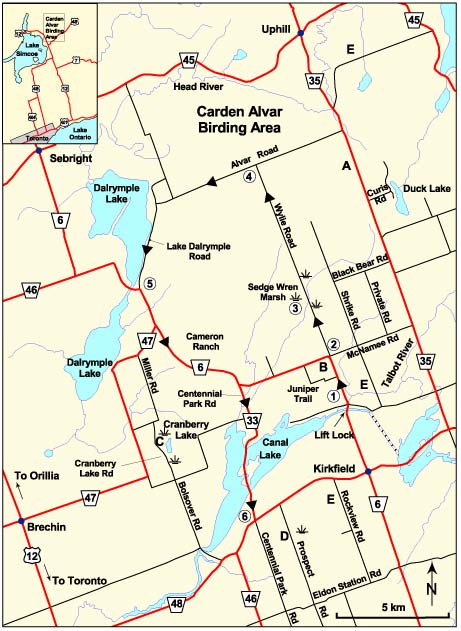
Getting to Carden: The Carden Alvar is a 1.5 hour drive (125 km or 75 mi) northeast of Toronto. See small inset map at
top left of map. To print a full page map see ?????.
Carden is an easy day
trip from the Hamilton to Oshawa corridor. Departing from Toronto, take
Highway 401 or Don Valley Parkway to Highway 404 north to Newmarket. Exit to
Davis Drive and go right (east) to provincial Highway 48. Turn left (north) on 48 and
continue to where it meets provincial Highway 12. Go left (north) on Highway 12 about 12.5 km and exit right (east) to
Durham Highway 48, which becomes Kawartha Road 48. Follow 48 for 19 km
to Kirkfield. At main intersection, turn left (north) on Kirkfield Road 6 and go
3 km to the Lift Lock where the birding tour begins.
Birding Tour - see map
Tour Overview: The 35 km (21 mile) route
begins at the Kirkfield Lift Lock and ends at Highway 48 about 5.5 km west of Kirkfield. The 6
stops are enclosed in circles on the map and distances between stops are given
in the route descriptions. At Stop 1 set odometer to zero. Distances between
stops are cumulative. Relax and go slowly. Bring a lunch and get set to
experience an abundance of Ontario's grassland and shrubland birds as they were
75 years ago before intensive agriculture. Refer often to annotated
list of birds. Scan with binoculars the tops of shrubs, tufts
of grass, boulders, dead trees and fences for singing birds. Use your
telescope to get great views grassland birds.
1. Kirkfield Lift Lock: km 0. The
Trent-Severn Waterway, operated by Parks Canada, connects Lake Ontario and Lake
Huron. The hydraulic Lift Lock is the second largest in the world. There is a
pay parking lot on the left just after the underpass. The facilities include
washrooms, picnic area and nearby restaurant. If you return later for a picnic
lunch at the Lift Lock, the birding is excellent. Take the stairs to the top of
the Lift Lock. Scan for hawks, Osprey and Turkey Vulture. Check the swallows for
Cliff and Northern Rough-winged. Also bird the narrow trail going west 0.4 km
along the north edge of the canal to where it meets the Talbot River. Be careful
along the edge of the canal. Return by going up the bank and birding the meadow
and shrubbery back to the Lift Lock. You cannot get lost here being surrounded
by the Talbot River, canal and road. This is public land owned by the federal
government.
2. Wylie Road: km 2.6. From the Lift Lock,
drive 2.5 km north, turn right (east) on McNamee Road where Kawartha
Road 6 turns sharply to the left. Then turn left (north) almost
immediately on Wylie Road (first road) and park on the shoulder.
Wylie Road ends 9.4 km to the north at a "T" intersection (Stop 4).
You will soon discover why this is the best early summer birding
road in southern Ontario. Watch for Upland Sandpiper, Eastern
Kingbird, Eastern Bluebird, Horned Lark, House Wren, Brown Thrasher,
Savannah Sparrow, Vesper Sparrow, Bobolink, Baltimore Oriole,
Eastern Meadowlark and many more species. Drive slowly, stopping
frequently to enjoy the multitude of birds. In the large meadow just
north of the house on the left, listen and look for Grasshopper
Sparrow. Watch for Loggerhead Shrike between 0.4 and 0.8 km north of
the house.
|
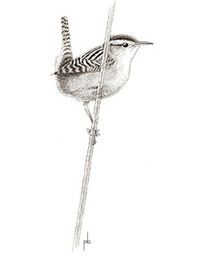 |
3. Sedge Wren Marsh: km 5.4. There is a
small parking area on the left just before the marsh or park only
one car well to the side on the bridge to allow others to pass. This
intriguing wetland is designated a provincially significant
wetland and it is the most reliable location to find Sedge Wren.
Walk the road on both sides of bridge. Listen and watch for Alder
Flycatcher, Common Yellowthroat and Swamp Sparrow. Trees and shrubs
on both sides of the marsh along the road provide excellent birding.
At dawn and dusk, the marsh is a good spot to hear and see Common
Snipe, American Bittern, Common Nighthawk and Whip-poor-will
(heard). You may hear Virginia Rail and Sora. Yellow Rail is usually
heard here from late April to late May; peak calling is early to
mid-May. |
4. To Carden "T": km 12. It is 6.6 km from
Sedge Wren Marsh to the Alvar Road or Carden T. This section goes
through dry and wet meadows and scrub forests rich in songbirds.
Drive slowly and stop several times. Golden-winged Warbler, Indigo
Bunting, Eastern Towhee and Field Sparrow are in the scrubby areas
with scattered trees. Listen for Clay-colored Sparrow about 0.5 km
before the T. Watch for patches of Prairie Smoke, a characteristic alvar wildflower. At night, drive and watch for the bright eye shine
of Common Nighthawk and Whip-poor-will sitting on the road. Listen
for Coyotes.
5. To Kawartha Road 6: km 21. Turn left
(west) at the "T" onto Alvar Road towards Lake Dalrymple. It is 4.7 km to the next
left turn at the Lake Dalrymple Road. This section goes through a coniferous forest
with several small alvar openings. Singing Hermit Thrush, Magnolia Warbler,
Yellow-rumped Warbler, White-throated Sparrow, Purple Finch and sometimes
Evening Grosbeak lend a distinct northern flavour. Turn left at the intersection
with the Lake Dalrymple Road and soon you will enter a cottage area on the east shore
of Lake Dalrymple. There is a resort store here if you need a drink, snack,
washroom break or gasoline. South of the store 1.3 km, you can get a good view
of the lake opposite a rock cut on the left. Check for Black Terns and other
water birds. Continue to the junction with Kawartha Road 6, where there may be
Purple Martins at the house on the left.
6. To Highway 48: km 35. Turn left
onto Kirkfield Road 6. Go 5 km to the large
open alvar on your left. This is the Cameron Ranch. Scan the ranch for grassland
birds including Loggerhead Shrike. In 2004 there were six pairs on
the ranch. Continue 2 km and turn right on Kawartha Road 33 which leads to the causeway
across Canal Lake. There are several Osprey nests along the causeway. Watch for
Common Loons and Common Terns. Continue 3.5 km to Highway 48, where the tour
ends. Turn right for Toronto or left for Kirkfield.
|
|
More Birding Areas - see map
For locations below see letters
A to E on map.
A. Victoria Road 35: Instead of going left (west) on Alvar Road at Stop 4,
go right (east) to Kawartha Road 35. Be careful turning right (south) at this
blind intersection. Kawartha Road 35 is paved and traffic is usually light. Bird
your way to Highway 48. Turn right and go 4.5 km to Kirkfield. Or go east to
Kawartha Road 35 from Kirkfield and bird it going north. Do not confuse this
road with provincial Highway 35 farther east at Coboconk.
B. Juniper Trail: Accessible from Kirkfield Road 6 on left 1 km
north of the Lift Lock. Most grassland birds, including Loggerhead
Shrike, are possible here. Allow 2 hours to walk a 4 km return trip.
Do not drive Juniper Trail without a 4-wheel drive.
C. Cranberry Lake: Birding is excellent along the very narrow 3.0 km road
on the west side of Cranberry Lake. Black Tern and Least Bittern breed here.
Listen for Marsh Wren and Sandhill Crane. Yellow Rail has been heard
here in May.
D. Prospect Road: The former Eldon Township has excellent birding.
Prospect Road (Concession 5) goes south from Highway 48 about 4.0 km west of Kirkfield.
It is 11 km to Glenarm Road 8 through scrub, woodlots, meadows, marshes and swamps. Of interest is
the large marsh 2.5 km south of 48. Sora, Virginia Rail, and Least Bittern are
found (heard) here. Yellow Rail has been heard here in May. Some birders say that Eldon reminds
them of the Rainy River District in far northwestern Ontario.
E. Exploring: Look on map for the letter E to explore other roads.
Annotated List of Carden Alvar Birds
This list covers the main breeding season from mid-May to mid-July. Abundance status is given for each species. Specialty
birds are shown in italics and they have extra information on habitat, voice and
finding tips. Vagrants and most very rare birds are not included, but any bird
recorded in southern Ontario could occur. For the official Ontario
Bird Checklist see
www.ofo.ca/obrc/chcklst.htm
Loons, Grebes, Cormorants:
Common Loon is uncommon. Pied-billed Grebe is rare. Double-crested
Cormorant is uncommon and increasing.
Herons, Bitterns: American Bittern is fairly common but
secretive. Stop 3 is the best spot. Most often seen in flight. Listen for its
deep bass pump-er-lunk at dawn and dusk or on cloudy days. Scan short grass
areas in the direction of its song for a bitterns bill and head pointing up. Least
Bittern is very rare and secretive in large cattail marshes. Sings a low
cuckoo-like coo-coo-coo-coo at dawn and dusk. Best spots are Cranberry Lake and
Prospect Road marsh. Great Blue Heron is fairly common. Green Heron is rare in
swamps with dead trees.
Ducks, Geese: Canada Goose, Mallard and Blue-winged Teal are
fairly common. Wood Duck (uncommon) and Hooded Merganser (rare) are secretive in
summer. Other ducks are occasional in summer.
Diurnal Raptors: The following 5 species are fairly common,
usually seen in open areas: Turkey Vulture, Osprey, Northern Harrier, Red-tailed
Hawk and American Kestrel. The next 5 raptors are secretive, usually staying in
the forest or seen flying across openings to another woods. All soar in the open
at times: Red-shouldered Hawk (rare), Broad-winged Hawk (uncommon),
Sharp-shinned Hawk (uncommon), Cooper's Hawk (uncommon), Northern Goshawk (rare).
Merlin is increasing.
Grouse, Turkeys: Ruffed Grouse is uncommon. It drums at dusk and
early morning to early June. Wild Turkey is uncommon and increasing.
Rails: Yellow Rail is rare migrant in May and occasionally may
breed. It prefers short grass/sedge marshes with shallow water. Listen for rapid
clicking tic-tic, tic-tic-tic at dawn and dusk, all night, and sometimes on cloudy
days. Stop 3 is the best spot, but also heard at Cranberry Lake and Prospect
Road marsh. Virginia Rail is common. Sora is uncommon. Common Moorhen and
American Coot are very rare.
Cranes: Sandhill Crane is rare but increasing. Listen and watch
for it at Sedge Wren Marsh (Stop 3) and Cranberry Lake. Its far carrying vibrant
gar-oo-ooo call is usually heard before the crane is seen.
Plovers: Killdeer is a fairly common breeder.
|
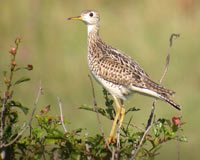 |
Sandpipers: 1. Upland Sandpiper is fairly common in dry short
grass fields. Listen for its curlew-like song and calls. Often perches on fence
posts. Its shallow quavering wing beats suggest a Spotted Sandpiper. 2. Common
Snipe is fairly common in marshes and wet meadows. Often perches on posts. Listen
for its hollow ho-ho-ho-ho-ho-ho made by outer tail feathers as it dives through
the air. Becomes elusive after mid-June. 3. American Woodcock is fairly common
but rarely seen. Ground call at dusk and dawn is a nasal nighthawk-like peent,
given every few seconds in open areas near woods. Displays up to early June. 4.
Spotted Sandpiper is fairly common breeder. 5. From late April to early June, a
few migrant shorebirds are seen in wet areas: Greater and Lesser Yellowlegs,
Solitary Sandpiper and Least Sandpiper are regular. |
Gulls, Terns: Ring-billed Gull is fairly common. Herring Gull is
uncommon. Common Tern breeds at Canal Lake. Black Tern breeds at Cranberry Lake
and marshy narrows of Lake Dalrymple.
Pigeons, Doves: Rock Pigeon is uncommon. Mourning Dove is common.
Cuckoos: Black-billed Cuckoo is uncommon and secretive in thickets
with scattered trees. Arrives in late May and increases during outbreaks of Tent
Caterpillars. More often heard, but sometimes seen flying low across openings.
Yellow-billed Cuckoo is rare in similar habitat.
Owls: Great Horned Owl is heard year round. Barred Owl is rare.
Short-eared Owl is seen rarely at dusk and dawn hunting over meadows. Long-eared
Owl is heard occasionally. Northern Saw-whet Owl calls from mid-February to May.
Eastern Screech-Owl is very rare.
Goatsuckers: Common Nighthawk is common and conspicuous at dusk
(often day active) after mid-May in open areas. Call is a nasal bizert and it
performs spectacular booming nose dives. The American Woodcock's call is mistaken for a
nighthawk, but it comes from the ground whereas nighthawk calls in flight. A
nighthawk heard before mid-May is probably a woodcock. Whip-poor-will is common
in young woodlands with openings. Begins loud song at dusk. At night, watch for
the bright reflective eye shine of both Whip-poor-will and nighthawk sitting on
back roads.
Swifts, Hummingbirds, Kingfishers:
Chimney Swift is rare. Ruby-throated Hummingbird is fairly common.
Belted Kingfisher is uncommon.
Woodpeckers: Red-headed Woodpecker is a rare and declining breeder
in open areas with scattered large dead trees used for nesting. Other
woodpeckers, except Northern Flicker, are hard to find in summer. Yellow-bellied
Sapsucker, Downy, Hairy and Pileated Woodpeckers (most often seen in
flight) are
regular. Listen for taps and calls.
Flycatchers: 1. Alder Flycatcher is fairly common in wet alder
thickets. Song is raspy wee-bee-o often given from a dead branch. 2. Willow
Flycatcher is uncommon but increasing in willows, dogwoods and shrubs,
preferring drier sites than Alder. Learn its fitz-bew song. 3 Eastern
Wood-Pewee, Least Flycatcher, Eastern Phoebe, Great Crested Flycatcher and
Eastern Kingbird are common. Learn their songs.
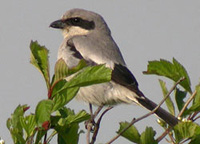
Shrikes: Loggerhead Shrike is an endangered species. In
2004 there were about 13 breeding pairs. Look
for shrikes in actively grazed pastures with short grass and scattered clumps of
hawthorns, for example, in areas where the cow symbols are on the map. Ungrazed
areas quickly become unsuitable breeding habitat because they overgrow with tall
grasses, shrubs and trees. Northern Shrikes occur in Carden from late September
to late April, but breed in the northern Ontario. See
www.ofo.ca/shrike.htm for
shrike identification. You can print a copy.
Vireos: Listen for their distinctive songs, but they are hard to
see. Warbling Vireo (tall open deciduous trees) and Red-eyed Vireo (deciduous
woods) are common. Yellow-throated Vireo is very rare in mature oak/maple woods.
Blue-headed Vireo is rare in dry mature coniferous woods.
Jays, Crows, Ravens: Common Raven is uncommon but increasing and spreading
south. Listen for adults distinctive croak or high pitched calls of young.
American Crow and Blue Jay are fairly common.
Larks: Horned Lark is uncommon in open areas of short grass and bare
ground associated with heavy cattle grazing. Sometimes sings from rocks and fence
posts. Caution: Juvenile Horned Larks are mistaken for pipits or longspurs, but
these species do not summer in southern Ontario. Horned Larks breeding in Carden
are the Prairie Horned Lark (Eremophila alpestris praticola) subspecies.
Swallows: Tree and Barn Swallows are common. Northern Rough-winged
and Cliff Swallows are uncommon. Bank Swallow is rare. Purple Martin is
rare and declining.
Chickadees, Nuthatches, Creepers: Black-capped Chickadee is
fairly common. Red-breasted (conifers) and White-breasted (hardwoods) Nuthatches
are uncommon. Brown Creeper (wet woods) is uncommon. All hard to find in summer.
Wrens: Learn distinctive songs. 1. Sedge Wren is uncommon in
sedge/grass marshes with scattered shrubs, not in cattails. Learn tip-tip-tip titititititititititi song. Sings partly hidden in tuft of grass or in a low
bush, sometimes in the open! 2. Marsh Wren is uncommon in cattail
marshes, not in sedge/grass marshes. Sings its distinctive rattling
song all day and on bright nights. Best spots are Cranberry Lake and marsh along Prospect Road. 3. House
Wren is common. 4. Winter Wren is rare in wet woods.
Kinglets and Gnatcatchers: Golden-crowned Kinglet is rare and hard to see in tall
dense spruce. Listen for its high pitched calls and song. Blue-gray Gnatcatcher
is very rare.
Thrushes: Eastern Bluebird is common at nest boxes along back
roads. American Robin is common. The following are secretive and usually heard
only: Hermit Thrush (open coniferous) is fairly common. Veery (moist deciduous
edges) and Wood Thrush (mature deciduous) are uncommon.
Catbirds, Mockingbirds, Thrashers: 1. Brown Thrasher is fairly common in
dry thickets near young woods. Secretive. Sings from a high perch. 2. Gray
Catbird is uncommon, preferring moister habitats. Sings from a low to medium
height perch. 3. Northern Mockingbird is very rare.
European Starling: Common and widespread breeder.
Waxwings: Cedar Waxwing is fairly common after late May.
Warblers: Study songs and habitats. 1. Golden-winged Warbler is
uncommon in moist alder thickets and young aspens on drier sites. Listen for its buzzy
bee bz bz bz song, first note loudest. Singing male perched at a distance
looks like a chickadee! Blue-winged Warbler and hybrid Brewster's Warbler are very
rare. 2. Alvar Road is best spot for many of the following regular species.
Learn their songs: Nashville Warbler (young open woods), Yellow Warbler
(aspen/alder/willow near water), Chestnut-sided Warbler (shrubby woodland
edges), Magnolia Warbler (small spruce/fir), Black-throated Blue Warbler (understory
shrubs of deciduous and mixed woods), Yellow-rumped Warbler (mixed woods),
Black-throated Green Warbler (tall evergreens), Blackburnian Warbler (tall
evergreens), Black-and white Warbler (moist deciduous and mixed woods), American
Redstart (woodland edges), Ovenbird (dry closed canopy deciduous woods),
Northern Waterthrush (wooded swamps), Mourning Warbler (low bushy openings),
Common Yellowthroat (swamps/marshes with bushes) and Canada Warbler (moist mixed
woods).
Tanagers: Scarlet Tanager is uncommon in mature mixed woods.
Sings from a high perch, but hard to spot.
Sparrows: 1. Eastern Towhee is fairly common but secretive in dry,
partly open scrublands with tangled undergrowth and scattered young trees.
Sometimes sings from a high dead limb. Heard calling chewink from tangles.
Responds to pishing and squeaking. 2. Clay-colored Sparrow is uncommon in dry open
scrubby fields, usually with scattered small conifers. Also found in Christmas
tree plantations in Eldon Township. Often found by hearing its buzzy song. 3. Field Sparrow
is fairly common in dry open scrub. Learn its song. 4. Vesper Sparrow is fairly
common in very short dry grass pastures with some bare ground. Other sparrows
prefer taller grass. 5. Grasshopper Sparrow is fairly common but secretive in
dry grass meadows with scattered perches. Sings from a low bush, rock or fence.
6. Henslow's Sparrow is an endangered species. Overly reported from Carden.
Fairly common in southern Ontario in 1960s, but it has declined to a few
sightings in recent years, mostly spring migrants at Point Pelee. Its
disappearance is a mystery as suitable habitat remains. Prefers taller grass
fields, often moister than Grasshopper Sparrow. Secretive, rarely seen unless
singing from a low bush or tussock of grass at dawn and dusk. Sings at night too.
Be sure to hear its distinctive insect-like tes-lick song, second syllable
louder. Note its greenish face and reddish wings. 7. Listen for the very rare
Le Conte's Sparrow in slightly damp tall grass fields. 8. Other sparrows: Chipping,
Savannah, Song and Swamp Sparrows are common. White-throated Sparrow is uncommon.
Cardinals, Grosbeaks, Buntings: Northern Cardinal is rare.
Rose-breasted Grosbeak is fairly common. Indigo Bunting is uncommon in tangles,
openings and tall trees, often sings from a high dead branch.
Blackbirds, Orioles, Meadowlarks: Brewer's Blackbird is rare around cattle and grazed
areas. It likes fences and road shoulders. Other blackbirds: Bobolink,
Red-winged Blackbird, Common Grackle, Brown-headed Cowbird and Baltimore Oriole
are common. Eastern Meadowlark is common. Western Meadowlark is very rare and
declining.
Finches: Purple Finch and House Finch are uncommon. American
Goldfinch is common. Evening Grosbeak is rare and irregular.
House Sparrow: Rare and declining around farms and villages.
More About Carden
Alvars: Alvars are globally rare habitats
supporting many threatened and endangered species. Alvars are naturally open areas of flat limestone or marble
bedrock either at the surface (classic alvar pavement) or covered with thin
soils and a sparse vegetation of lichens, mosses, herbs and shrubs. Trees are
absent or scattered, rarely forming a closed canopy. They are harsh places for
many plants to grow. Plant growth is restricted by shallow soils and extremes of
spring wetness and summer drought. Recent studies indicate the important ecological role of
periodic fires in maintaining alvar habitats. Much of the Carden Alvar is ranchland. Cattle grazing
helps maintain the short grass open habitats preferred by Loggerhead Shrikes and
many grassland birds. However, heavy grazing damages sensitive alvar habitats
and plants. There are
four active quarries in Carden and others are expected because of increasing
demands for valuable mineral aggregates in the Greater Toronto Area.
Ecotourism: Support local businesses.
Birders contribute to the economy by buying gas, eating at restaurants and using
accommodations. Proudly wear your binoculars everywhere you go. Tell people
about the grassland birds and natural values of the Carden Alvar.
Services, Accommodation, Food and Fuel: The Sir William
Mackenzie Inn, a bed and breakfast in Kirkfield, welcomes birders. Birding is
excellent on the trails of its 5.3 ha (13 acre) estate. Call toll free
800-266-6025 or phone/fax 705-438-1278 or website
www.themackenzieinn.com. Motels are
along Highway 48 at Beaverton (Budget Inn 705-426-1800) and Orillia. Camping is
available at Balsam Lake Provincial Park, 12 km east of Kirkfield on Kawartha Road 48. Call toll free
888-668-7275 to reserve a campsite in a provincial park.
Restaurants are in Kirkfield, the Lift Lock and Lake Dalrymple Resort. Gas
stations are along Highway 48 just east and west of Kirkfield.
Back Roads: The back roads are narrow, but
traffic is usually light. Be careful not to block roads or laneways. There are
some good spots to pull off, but check them on foot first. In spring and after
heavy rains, some roads develop mud holes and washouts. Drive slowly, find a
safe place to park, then bird from the roadside.
Birding Ethics: Most of Carden is private
property. Be friendly to ranchers and others using the back roads. Do not
trespass. Birds are easily seen from roadsides without harming them. Always act
in the best interest of birds and their habitats. There is a concern that
endangered species, such as the Loggerhead Shrike, could be disturbed by birders
and photographers. Ontario's Endangered Species Act prohibits (1) the killing,
injuring or interfering with endangered species and (2) the interference with or
destruction of the habitat of endangered species. The penalty is a fine up to
$50,000 or imprisonment up to two years or to both. Report anyone disturbing
endangered species to the Ministry of Natural Resources at 705-286-1521.
Acknowledgements: I thank Jean Iron for photos and for setting up
this webpage. Peter Burke did the illustration of the Sedge Wren. Andrew Jano
kindly produced the map.
Ron Pittaway 4 Anson Street, Box 619, Minden ON K0M 2K0. Phone 705-286-3471 or 416-445-9297. Email:
jeaniron@sympatico.ca
|